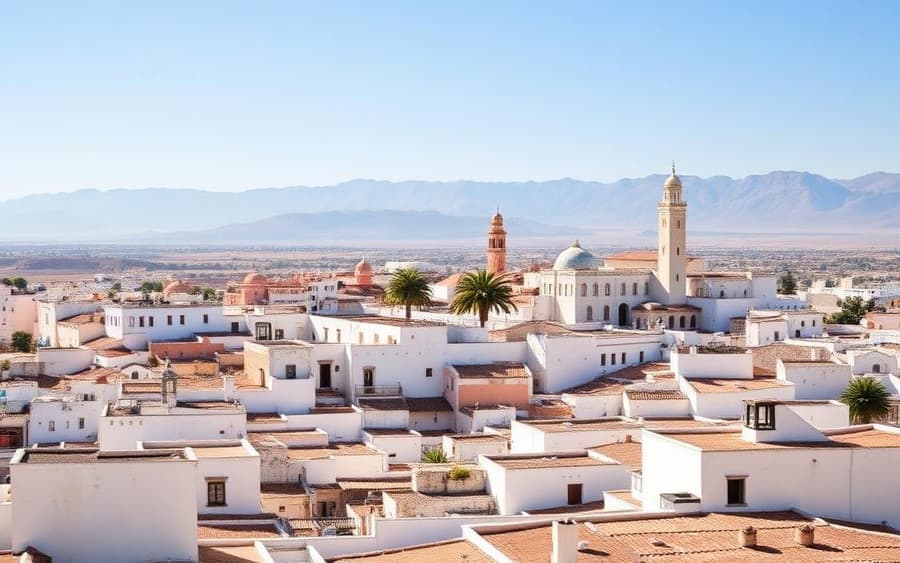
History of the Medina
From Roman Tamuda to UNESCO Heritage: over 2,000 years of living history
Before reconstruction
Tamuda and the origins of a strategic site between mountain and sea.
Before the arrival of Andalusian families, the territory of Tetouan already had a long history. The Roman city of Tamuda, a few kilometers away, shows this area was a crossroads of civilizations since antiquity.
Legacy
The pre-Islamic legacy remains visible in the ruins of Tamuda.
The Andalusian reconstruction
Sidi al-Mandri and Granada families rebuild Tetouan as an Andalusian refuge.
In 1485, Sidi Ali al-Mandri led the reconstruction of Tetouan alongside families expelled from Nasrid Granada. They brought their building techniques, urban organization, crafts, and culture.
Legacy
The current urban layout, patios, artisan techniques, and neighborhood culture are direct heritage of this foundational moment.
The Andalusian imprint
Three centuries of cultural, commercial, and spiritual development that defined the medina's character.
During the 16th, 17th, and 18th centuries, the medina consolidated its identity. Artisan guilds were established in specialized souks, new zawiyas and mosques were built.
Legacy
The souks, zawiyas, and neighborhood organization preserved today were born during this golden period.
Later evolution
The Spanish protectorate and modernization transformed the medina's surroundings without destroying its essence.
With the arrival of the Spanish Protectorate in 1912, Tetouan underwent a profound urban transformation. The European ensanche was built alongside the medina.
Legacy
The coexistence of medina and ensanche makes Tetouan a unique case of urban duality in North Africa.
Heritage and conservation
UNESCO declares the medina a World Heritage Site, recognizing its universal value.
In 1997, UNESCO inscribed Tetouan's medina on its World Heritage List. The recognition highlights the exceptional authenticity of its urban layout.
Legacy
Tetouan's medina is today one of the few in North Africa where Andalusian urbanism can still be clearly read.